If you searched for a website for a construction company, you are probably past the point of wanting design inspiration. You want to know what the site actually needs to include, what it should cost, and whether it will hold up when a prospect who found you through a referral or a search decides to check you out before calling.
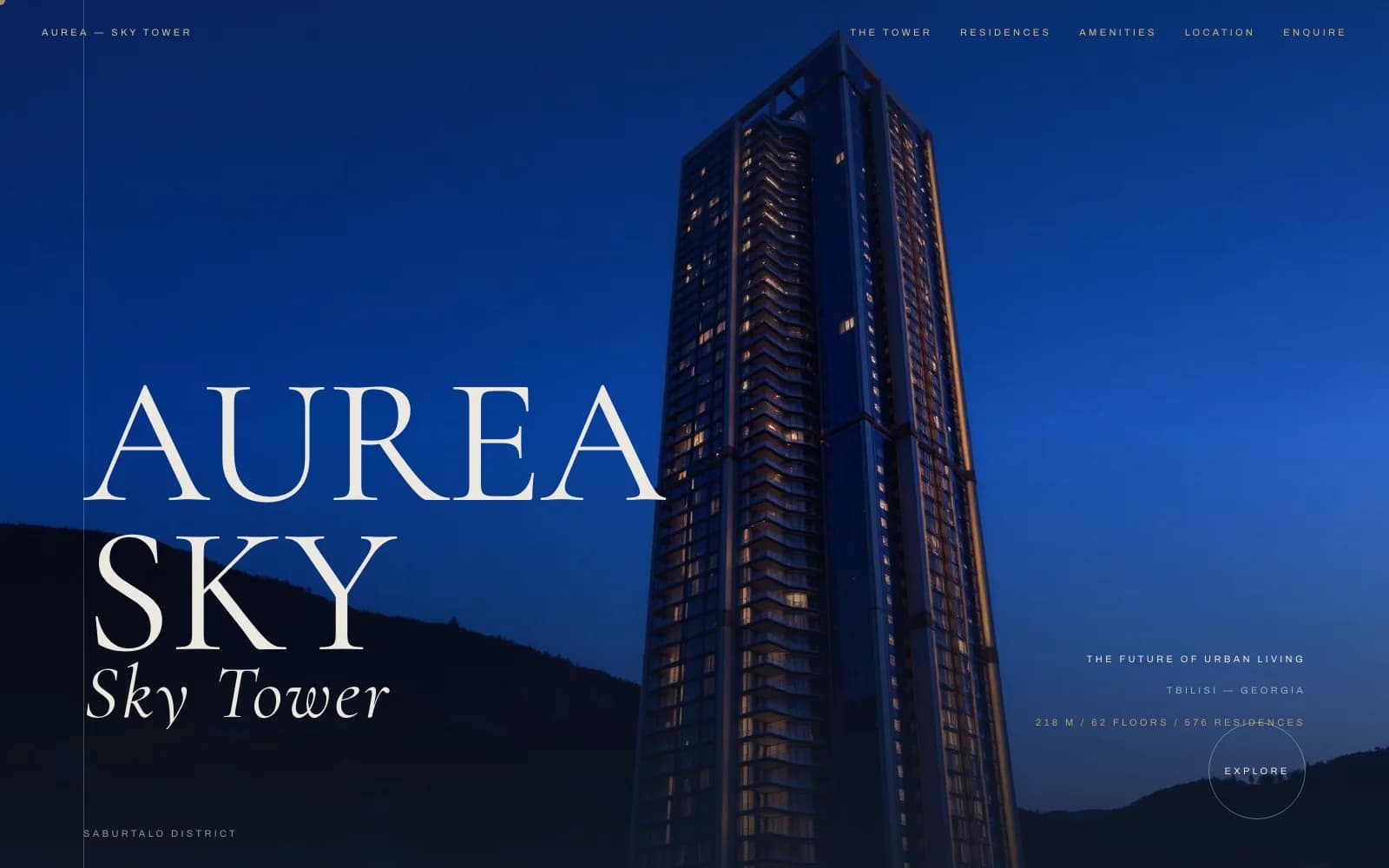
We recently built exactly this kind of site for Aurea Sky Tower, a 62-floor, 576-residence tower under development in Tbilisi, Georgia. It is a property development project rather than a general contracting business, but the underlying problem is the same one every construction company website has to solve: turn a stranger's first look into enough trust to start a conversation about a project that costs real money.
What a Construction Company Website Actually Needs to Do
Prove the Company Is Real Before Anyone Calls
Construction and property development are trust-heavy purchases. Nobody hands over a deposit, signs a contract, or books a consultation with a company that feels unverifiable. Research on contractor websites puts a number on this instinct: more than 68% of construction clients now check a builder's online presence before contacting them, and a large share of consumers will quietly drop a business that has no credible web presence at all rather than ask why.
That means the site's first job is not to impress. It is to answer, within seconds, the questions a skeptical prospect is silently asking: is this a real, active company, has it built anything like my project before, and can I trust the people behind it.
Show the Work, Not Just Claim It
Construction buyers do not want adjectives. They want evidence: photos of finished or in-progress work, real project facts (scale, location, timeline), and specifics that a company without real projects could not credibly fake. This is why generic stock-photo contractor sites read as untrustworthy almost instantly, regardless of how polished the layout is.
Get Contact Details in Front of the Right Project Type
A construction or development company rarely sells one thing to one audience. A general contractor might handle residential renovations and commercial fit-outs. A developer might be marketing several projects at different stages. The site needs to route each visitor toward the right project or service quickly, rather than funneling everyone into one generic contact form and hoping a human sorts it out later.
Case Study: Aurea Sky Tower, a 62-Floor Property Development in Tbilisi
The Brief
Aurea Sky Tower is a 218-meter, 62-floor residential development in Tbilisi's Saburtalo district, with 576 residences. Before a single apartment could be sold off-plan, the developer needed a website that matched the ambition of the building itself, one a buyer would trust with a serious reservation, at a price point where the site itself becomes part of the sales pitch.
The complication familiar to any construction or development website: there was no finished building to photograph. The site had to sell scale, quality, and lifestyle from architectural renders and hard facts, not from a gallery of completed units.
The Structure That Actually Sells
We built the site around five sections that mirror how a serious buyer actually evaluates a project, rather than a generic homepage-plus-pages layout: Tower, Residences, Amenities, Location, and Enquire. Each section answers one class of question a buyer has before they will fill out a form, floor count and unit mix, what amenities justify the price per square meter, where the building actually sits in the city, and how to take the next step.
Cinematic, GSAP-driven scroll motion reveals the tower's imagery, headline facts (218m, 62 floors, 576 residences), and key details in sequence as the visitor scrolls. Every section links back to a single, short enquiry action, so a buyer convinced by the Amenities section is never more than one click from starting a conversation. You can read the full breakdown, including how we handled mobile performance on a render-heavy build, in the Aurea Sky Tower case study.
The Result
The project moved from architectural brief to a launch-ready sales site in six weeks: two weeks defining the buyer-journey structure and preparing renders, two weeks building the site and layering in scroll-driven motion, and two weeks tuning performance and testing across devices before launch. That timeline held because content and structure were locked before any animation work began, not the other way around.
What to Include on a Construction or Property Development Website
- Verifiable company details. Registered name, location, years active, and licensing or credentials where relevant. This is the baseline trust signal, and its absence is the fastest way to lose a skeptical visitor.
- Real project evidence. Photography, renders, or footage tied to actual projects, with enough specific detail (location, scale, timeline) that the claims could not be copy-pasted onto a competitor's site.
- A clear scope statement. What kind of projects, what locations, what budget range. A visitor should know within one screen whether they are a fit, rather than filling out a form to find out.
- A short, obvious enquiry path. One clear action, repeated at natural decision points, not buried at the bottom of a long page or split across five different contact methods.
- Mobile performance that doesn't compromise on media. Mobile traffic now makes up 58.4% of visits to construction company websites, often from a link shared mid-conversation. A site with strong photography that loads slowly on a phone loses exactly the visitors it was built to convert.
- Process transparency. A brief outline of what happens after someone enquires. Uncertainty about "what happens next" is one of the most common reasons a warm lead goes cold.
Common Mistakes Construction Company Websites Make
The most common failure is not bad design, it is thin content dressed up in a good template. A site with generic stock photography, vague service descriptions, and no specific project evidence will not convert regardless of how modern it looks, because it does not answer the trust questions a construction buyer is actually asking.
The second most common mistake is a contact form as the only path forward, with no phone number, no response-time expectation, and no indication of what happens after submission. For a purchase this large, ambiguity reads as risk.
The third is treating mobile as an afterthought. If most first visits happen on a phone, shared through a link from a colleague or found through a search, a desktop-first build that degrades on mobile is optimizing for the wrong device.
How Long Does a Construction Company Website Take to Build
For a scoped project, six to eight weeks is a realistic range when content, photography, and structure are ready before the build starts. That was the timeline for Aurea Sky Tower, including a cinematic, scroll-driven build far more involved than a standard brochure site. Projects run longer when renders, copy, or brand direction are still being produced during development rather than before it.
How Much Does a Construction Company Website Cost
Cost tracks the amount of content, media production, and interaction the site needs, not the number of pages. A straightforward company site with strong photography, a project gallery, and a simple enquiry form costs meaningfully less than a cinematic, scroll-driven property site built to carry a seven-figure sales conversation. Rather than quoting a flat number, we scope cost against what the site actually needs to prove and to whom.
Ready to Build Yours?
If you're marketing a construction company, a development, or an off-plan project, compare the constraints above with our website design and development service. The Aurea Sky Tower case study is the relevant proof: a 218-metre, 62-floor, 576-residence sales journey delivered from architectural brief to launch-ready site in six weeks.