If you're searching for a website for a café, you've probably already noticed the problem: almost every café website looks the same, a hero photo, a menu grid, and a map link. That template works, technically, but it does nothing to make your café feel like your café instead of the one three doors down.
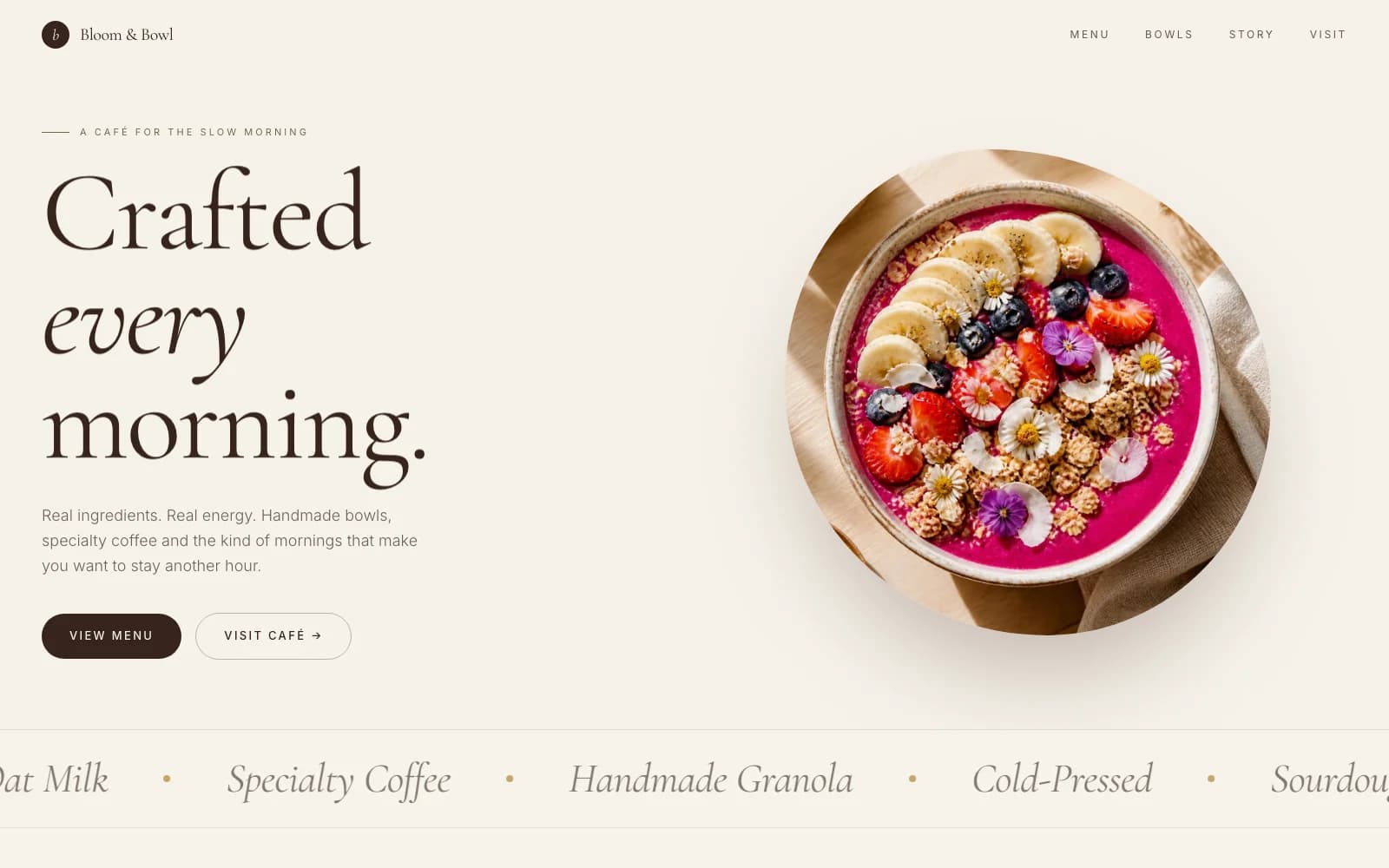
We ran into this directly building the site for Bloom & Bowl, a Copenhagen café built around a short, strict list of rules, real ingredients, house-roasted beans, and no rushed mornings. The brief was to make a website that felt as considered as the food, without falling into the same template every café site defaults to.
What a Café Website Actually Needs to Do
Get Checked Before Anyone Walks In
Diners research before they show up, and the numbers back up how much this matters. 77% of diners research a restaurant or café online before deciding to visit, and in the same survey, 68% said a poorly designed website has discouraged them from visiting a restaurant in the past. A café website isn't a brochure people glance at after they've decided. For a large share of visitors, it's the decision itself.
Trust signals matter just as much as design. 88% of diners trust online reviews as much as a personal recommendation, and Google reviews are the most-checked source by a wide margin. A site that hides or ignores this proof is leaving a trust signal on the table that visitors are actively looking for.
Sell With Photography, Not Copy
Nobody reads three paragraphs about your café's philosophy before deciding whether to visit. With little sales copy to lean on, the food and interior photography have to do almost the entire persuasion job on their own, which means photography quality is not a nice-to-have on a café site, it's the primary conversion asset.
Feel Like an Actual Place, Not a Listing
Café and brunch websites are one of the most templated categories online. Standing out usually means avoiding the default hero-photo-plus-menu-grid layout most competitors default to, and leading instead with the café's own voice and story.
Case Study: Bloom & Bowl, a Copenhagen Café
The Brief
Bloom & Bowl is a café built around a short, strict philosophy: real ingredients, house-roasted beans, and no rushed mornings. That's easy to say over a counter and hard to translate onto a website without it reading like every other café site. The brief was to design a restaurant website that felt as considered as the food, warm and editorial, unmistakably a café for people who care about ingredients, not a generic ordering page.
The Structure That Avoids the Template
Instead of opening with a hero photo and a menu grid, the homepage opens with the café's own words, why it exists, what it refuses to compromise on, before it ever shows a bowl, building trust the way a good in-person conversation with staff would. Serif display type, generous whitespace, and an asymmetric photo layout give the site a magazine-like feel that matches a slow-morning, craft-led brand instead of a fast-food ordering interface.
Signature bowls are presented as a seasonal, rotating feature rather than a fixed list, so the menu stays accurate without needing a rebuild every time the kitchen changes something. Every photograph was converted to WebP and served at responsive sizes through Next.js Image, so the editorial photography loads quickly instead of dragging the site down, a real risk on any image-led, photography-driven layout. "View Menu" and "Visit Café" sit as the two primary actions on the homepage, keeping the path from browsing to visiting short and obvious.
The Result
The project moved from brand direction to a fully live café website in three weeks: one week for direction and story copywriting, one week for editorial layout and component build, and one week for image optimization, cross-device checks, and launch. The full breakdown, including how the seasonal menu structure works, is in the Bloom & Bowl case study.
What to Include on a Café or Restaurant Website
- A story before a menu. Open with what makes the place worth visiting, not a generic hero photo. That's the difference between a café website and a directory listing.
- Real photography, not stock. Food and interior photography should carry most of the persuasion work, since visitors rarely read long sales copy before deciding.
- A current, honestly structured menu. Build it as a feature that can rotate seasonally rather than a fixed list that goes stale.
- Address, hours, and two clear actions. "View menu" and "visit" (or order, if relevant) should be impossible to miss on any device.
- Fast image loading. Photo-heavy sites need every image optimized and served responsively, or the photography built to convert becomes the reason visitors leave.
- Visible proof. Reviews or press mentions where you have them. Diners actively look for this before deciding to visit.
Common Mistakes Café and Restaurant Websites Make
The most common mistake is defaulting to the same hero-photo-plus-menu-grid template every competitor uses, which makes a genuinely distinctive café read as interchangeable with the place next door.
The second is treating the menu as a static PDF or image instead of structured content, which makes seasonal updates slow and often leaves outdated dishes live on the site.
The third is under-investing in photography while over-investing in layout. A polished template with mediocre food photos undersells a café far more than plain design with excellent photography.
How Long It Takes and What It Costs
A focused, single-page-led café website can realistically go from brand direction to launch in about three weeks, the same timeline as Bloom & Bowl, when photography and copy are ready early in the process. Sites that add online ordering, table reservations, or multiple locations take longer to scope and build. Cost follows the same pattern: it tracks how much original content, photography direction, and structure the site actually needs, not a flat per-page rate.
Ready to Build Yours?
If you run a café, bakery, or small restaurant and need a site built around your actual story and menu instead of a generic template, we can scope it with you. Explore our restaurant and hospitality solutions, see more of our portfolio, or get in touch to talk through your project.