Enrolments, not abandoned forms.
EdTech software development for students, parents and admins, on any phone.
-
Senior engineers
No juniors. No middlemen.
-
Fixed price
Overruns are on us.
-
Live in weeks
Weekly demos on staging.
-
You own the code
100% of the IP, day one.
EdTech software development is building learning platforms, student and parent portals, admissions systems, tutoring marketplaces and the lead flows that turn interest into enrolments. Key requirements: multilingual content, mobile-first screens, roles for students, parents, teachers and admins, privacy for minors, and integrations with payments and school systems. Yarify, a senior team in Prague, built the admissions platform for Osvita Poland in four weeks on Next.js.
One product, four people
Education is decided by more than one person. We design a clear path for each.
-
Student browses
On a mid-range phone
-
Parent pays
Fees, instalments, invoices
-
Teacher uses it
Every day, without training
-
Admin approves
Documents, deadlines, reports
EdTech software development we ship
-
Admissions platforms
Guided applications, document upload, status tracking, fee payments and CRM integration.
-
Student and parent portals
Schedules, progress, grades, messages and invoices, with separate views per role.
-
Learning platforms
Course catalogues, video lessons, quizzes, progress, certificates and subscriptions.
-
Tutoring and booking
Tutor profiles, availability calendars, booking, payments and lesson reminders.
-
Lead generation sites
Multilingual sites that answer families' real questions first and convert into booked consultations.
-
AI study and admin tools
Document checks and feedback drafts with human review. See AI development.

Risks we design for
-
Minors' data
GDPR with extra care: parental consent where required, minimal data, retention rules. FERPA and COPPA expectations for US clients, confirmed by their advisers.
-
Translations that drift
One content model for every language, with correct URLs, hreflang and local form formats.
-
Intake-day traffic spikes
Static pages, caching and queued form handling keep the site up at deadlines.
-
Accessibility
Keyboard navigation, contrast, screen reader labels and captions, as procurement increasingly expects WCAG.

Education platform we have shipped
Osvita Poland guides Ukrainian students into Polish universities. A five-step process, free consultations, answers before forms. Four weeks, Next.js and TypeScript.
-
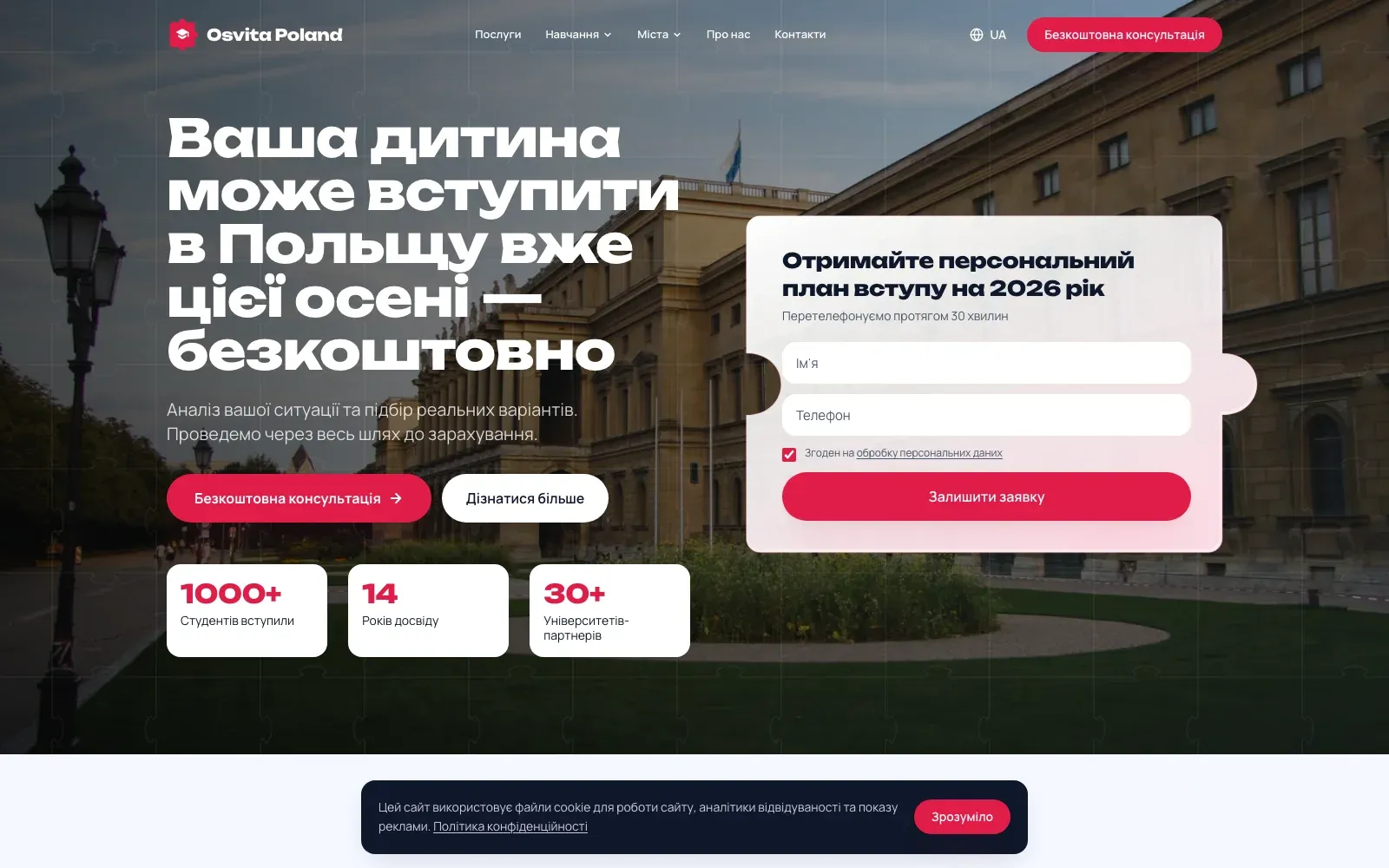
Osvita Poland: Admissions Made Clear
Ukrainian-first, mobile-first admissions site for a study-abroad consultancy. Five-step process, consultation form above the fold, Next.js and TypeScript, live in four weeks.

Live before the next intake
-
Map the decision · Week 1
Who browses, decides, pays and uses it daily. One flow per role.
-
Scope and fixed price · Week 1
Languages, roles, integrations and the one journey the first version must nail.
-
Weekly increments · Build
Staging URL early, pull requests in your repo, demos to share with teachers or advisers.
-
Launch on your calendar
Timed to admissions or course start, with load checks and funnel analytics.
What drives the cost
User roles, languages, self-hosted or integrated video and assessments, payment models, school system integrations and accessibility. An admissions site sits at the lower end; a learning platform with roles and payments is medium complexity.
Market ranges are in the MVP cost guide, and our scope checklist helps trim version one.
Fixed price. We eat the overruns.
For fixed-scope edtech builds, the quoted price for the agreed written scope is what you pay. If our estimate was wrong, the extra hours are on us. Changes you request are quoted first.
How MVP development worksRelated services
-
MVP development
Fixed-price MVP development. A senior team scopes it in writing, ships a deployed build early, demos weekly and launches a focused MVP in typically 8–12 weeks.
-
Web app development
Fast, SEO-ready web applications in Next.js and React: customer-facing apps, sales platforms and portals, with performance and search built into the architecture.
-
Next.js developers
Senior Next.js engineers for App Router builds, Pages Router migrations, caching and SEO fixes, Stripe and auth. Join your team monthly or own a fixed-price build.
-
MVP development cost
What an MVP costs in 2026 by complexity, region and pricing model: market ranges, timelines, hidden costs and an illustrative booking-app estimate.
-
SaaS
Multi-tenant SaaS products with Stripe billing, onboarding flows and churn analytics, built by senior engineers who own the code from schema to deploy.
Questions buyers ask us
How much does it cost to build an edtech platform?
Market surveys put simple builds around $15k–$40k and medium-complexity products around $40k–$100k. Admissions sites land low; learning platforms with roles and payments sit higher. We give a fixed written quote after a free scoping call.
Can you build a multilingual education website?
Yes. Osvita Poland serves Ukrainian families applying to Polish universities, and Astrooly runs in three languages. One content model keeps translations in sync, with correct URLs and hreflang per language and forms that handle local formats.
How do you handle students' and children's data?
Only what is needed, with retention periods, role-based access and logged access to sensitive records. Under GDPR, minors' data can require parental consent, so we build consent flows where your legal basis needs them. US clients confirm FERPA and COPPA specifics with their adviser.
Should we build a custom LMS or use an existing one?
If you only deliver courses, an existing LMS is usually cheaper. Build custom when your enrolment flow, marketplace or roles do not fit, or the learning experience is your product. We will recommend an existing tool when that is the honest answer.
How long does edtech app development take?
The Osvita Poland admissions site took four weeks. A learning platform with accounts, courses, progress and payments typically takes a few months. We plan the release around your intake or course calendar.
Can you add AI features to our learning platform?
Yes: AI-drafted assignment feedback, application document checks and admin automation. A human reviews anything a student sees, costs are tracked per user, and output quality is measured against examples you approve.
Keep reading
-
Osvita Poland: Admissions Made Clear
Ukrainian-first, mobile-first admissions site for a study-abroad consultancy. Five-step process, consultation form above the fold, Next.js and TypeScript, live in four weeks.
-
MVP development
Fixed-price MVP development. A senior team scopes it in writing, ships a deployed build early, demos weekly and launches a focused MVP in typically 8–12 weeks.
-
MVP development cost
What an MVP costs in 2026 by complexity, region and pricing model: market ranges, timelines, hidden costs and an illustrative booking-app estimate.
-
Web app development
Fast, SEO-ready web applications in Next.js and React: customer-facing apps, sales platforms and portals, with performance and search built into the architecture.
-
Marketing technology
Email outreach and campaign platforms, content automation pipelines and SEO and AI-search audit tools, built by engineers who have shipped all three.
-
SaaS
Multi-tenant SaaS products with Stripe billing, onboarding flows and churn analytics, built by senior engineers who own the code from schema to deploy.
Ship before the next intake.
Book a free 30-minute call. We map who decides, pays and uses it, and give you a fixed price for the first version.